
The Indigenous Relational Evaluation Architecture™ reimagines evaluation as a living relational process that helps communities, organizations, and systems learn, adapt, and transform together.
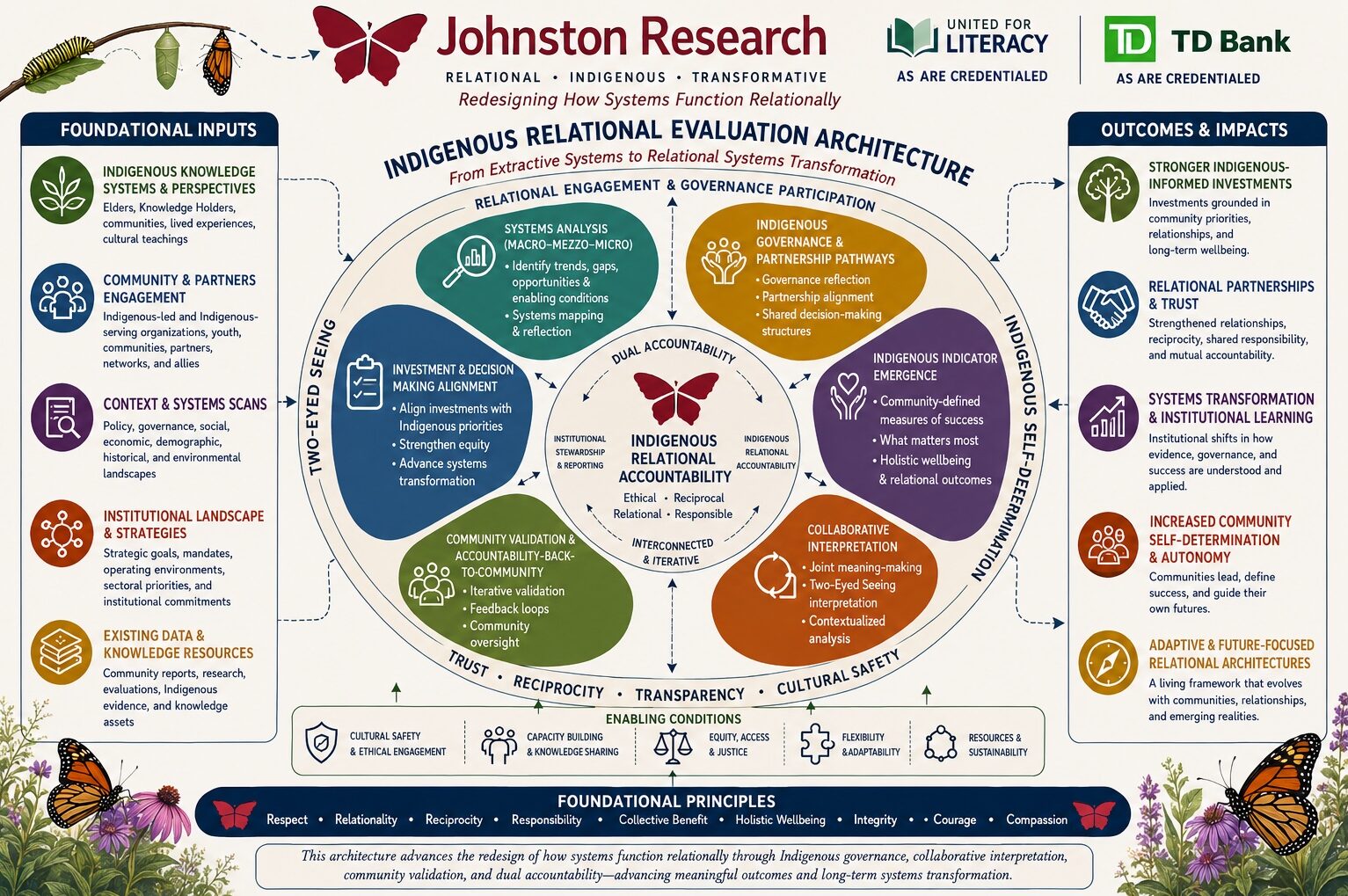
The Indigenous Relational Evaluation Architecture™ reflects an emerging generation of Indigenous evaluation practice.
Why This Matters for Organizations
Organizations today operate in increasingly complex environments where traditional evaluation approaches often struggle to capture the full realities of community change, relationship-building, trust, cultural impact, and long-term systems transformation. As expectations for reconciliation, Indigenous engagement, Indigenous data sovereignty, equity, and community accountability continue to grow, organizations require new ways of understanding success beyond conventional metrics and reporting frameworks.
The Indigenous Relational Evaluation Architecture™ provides organizations with a practical framework for strengthening decision-making, improving accountability, deepening community relationships, and creating more meaningful outcomes. By applying this architecture throughout planning, implementation, evaluation, governance, and strategic decision-making processes, organizations can better understand how their actions influence communities, identify emerging opportunities and challenges, support Indigenous self-determination, and build systems that are more responsive, ethical, sustainable, and relationship-centered. Rather than treating evaluation as a project completed at the end of a program, this model positions evaluation as an ongoing organizational learning system that helps institutions continuously adapt, improve, and transform alongside the communities they serve.
Reimagining How Systems Learn, Govern, and Transform
The Indigenous Relational Evaluation Architecture™ is a systems-based Indigenous evaluation framework developed by Johnston Research to support organizations, communities, governments, and institutions in understanding how meaningful transformation occurs through relationship, accountability, community engagement, and Indigenous knowledge systems.
Rather than viewing evaluation as a technical exercise focused solely on measurement and reporting, this model positions evaluation as a living relational process. At its centre is Indigenous Relational Accountability — a framework that recognizes that meaningful change emerges through relationships among people, communities, institutions, knowledge systems, and the environments in which they exist.
Grounded in Two-Eyed Seeing, Indigenous Self-Determination, relational engagement, and governance participation, the model integrates Indigenous and Western ways of knowing while maintaining Indigenous authority over meaning-making, interpretation, and community-defined outcomes. It acknowledges that systems do not transform through data alone; they transform through trust, reciprocity, accountability, learning, and collective action.
The architecture begins by examining the foundational conditions that shape any system, including Indigenous knowledge systems, community and partner engagement, institutional landscapes, policies, resources, histories, and environmental contexts. These foundational inputs influence how communities and institutions interact and how evaluation processes are designed and implemented.
At the centre of the model are six interconnected domains that drive transformation:
- Systems Analysis and Learning
- Indigenous Partnership Pathways
- Indigenous Indicators of Emergence
- Collaborative Interpretation and Meaning-Making
- Community Validation and Accountability
- Investment and Decision-Making Alignment
Together, these domains create a continuous cycle of reflection, learning, adaptation, and accountability. Through collaborative interpretation, Indigenous indicators, community validation, and shared decision-making, communities become active participants in defining success rather than passive subjects of evaluation.
The model is further supported by enabling conditions including cultural safety, ethical engagement, equitable power sharing, justice, transparency, accessibility, sustainability, and institutional readiness. These conditions help create environments where authentic participation and meaningful learning can occur.
The intended outcomes extend beyond traditional evaluation results. The architecture supports strengthened Indigenous-informed investments, deeper trust and partnerships, institutional learning, systems transformation, community self-determination, and future-focused relational governance. Ultimately, it seeks to redesign how systems function by placing relationship, responsibility, reciprocity, and community wisdom at the centre of decision-making.
The Indigenous Relational Evaluation Architecture™ reflects an emerging generation of Indigenous evaluation practice—one that moves beyond measuring programs to understanding how communities, organizations, and systems can learn, evolve, and transform together. It offers a pathway toward more ethical, responsive, culturally grounded, and sustainable approaches to evaluation in an era increasingly shaped by reconciliation, Indigenous self-determination, Indigenous data sovereignty, and community-led futures.